
Canadian Citizenship Test Pass Rate: The Real Numbers
If you're preparing for the Canadian citizenship test, you've probably wondered: how many people actually pass? And more importantly — how likely are you to pass?
The good news: the citizenship test pass rate is higher than most people think. But the numbers tell an interesting story — and understanding them can help you prepare smarter.
Let's look at the real data.
What Is the Official Pass Rate?
According to IRCC's own Evaluation of the Citizenship Program (published in 2020, covering 2013-2018), the first-attempt pass rate was 86.1%.
That means roughly 6 out of 7 people pass the citizenship test on their first try.
Here's a quick snapshot of what the test looks like today:
| Detail | Current Rules |
|---|---|
| Number of questions | 20 (multiple choice or true/false) |
| Passing score | 15/20 (75%) |
| Time limit | 45 minutes |
| Attempts | Up to 3 within a 30-day window |
| Format | Online, self-administered |
| Study source | Discover Canada guide |
How the Pass Rate Has Changed Over Time
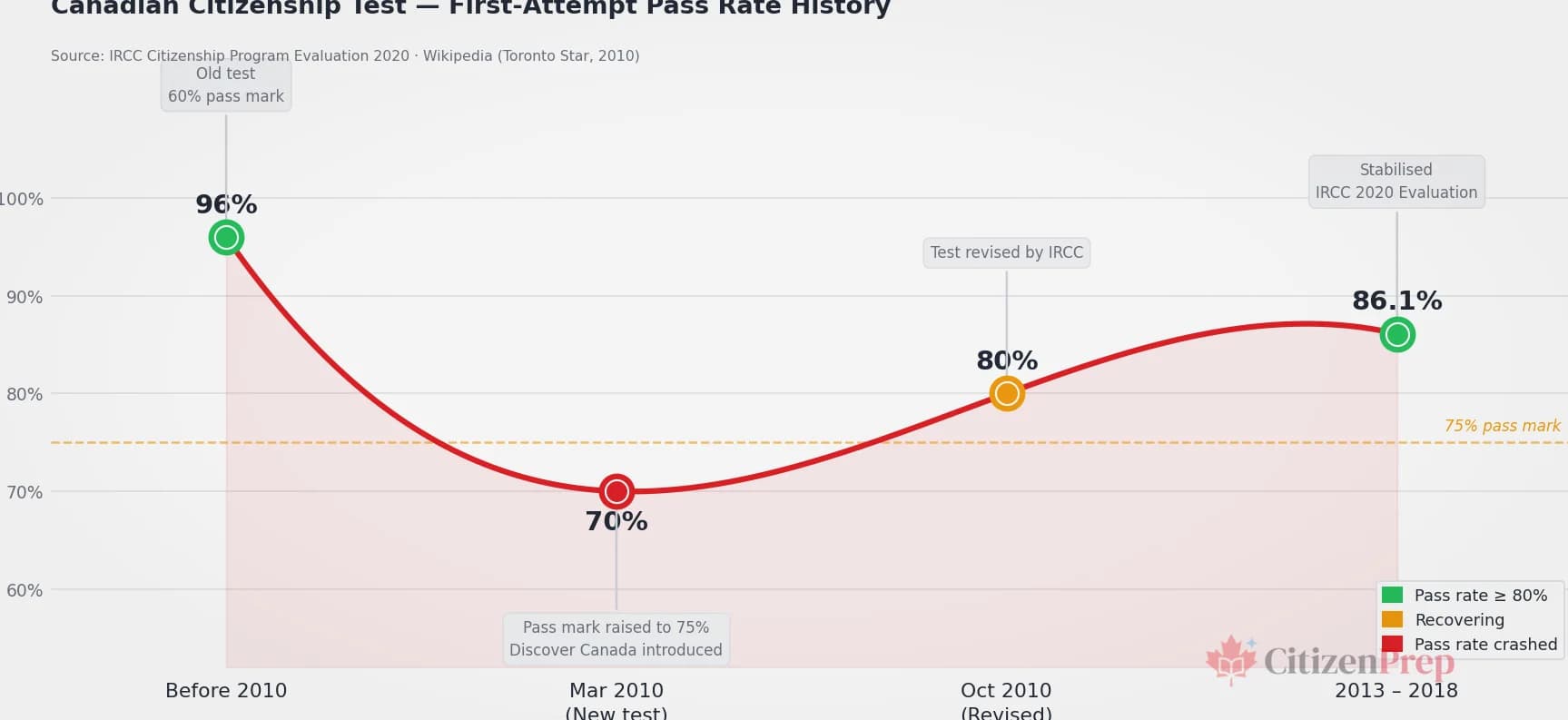
The citizenship test hasn't always been this challenging. Here's how the numbers shifted — and why:
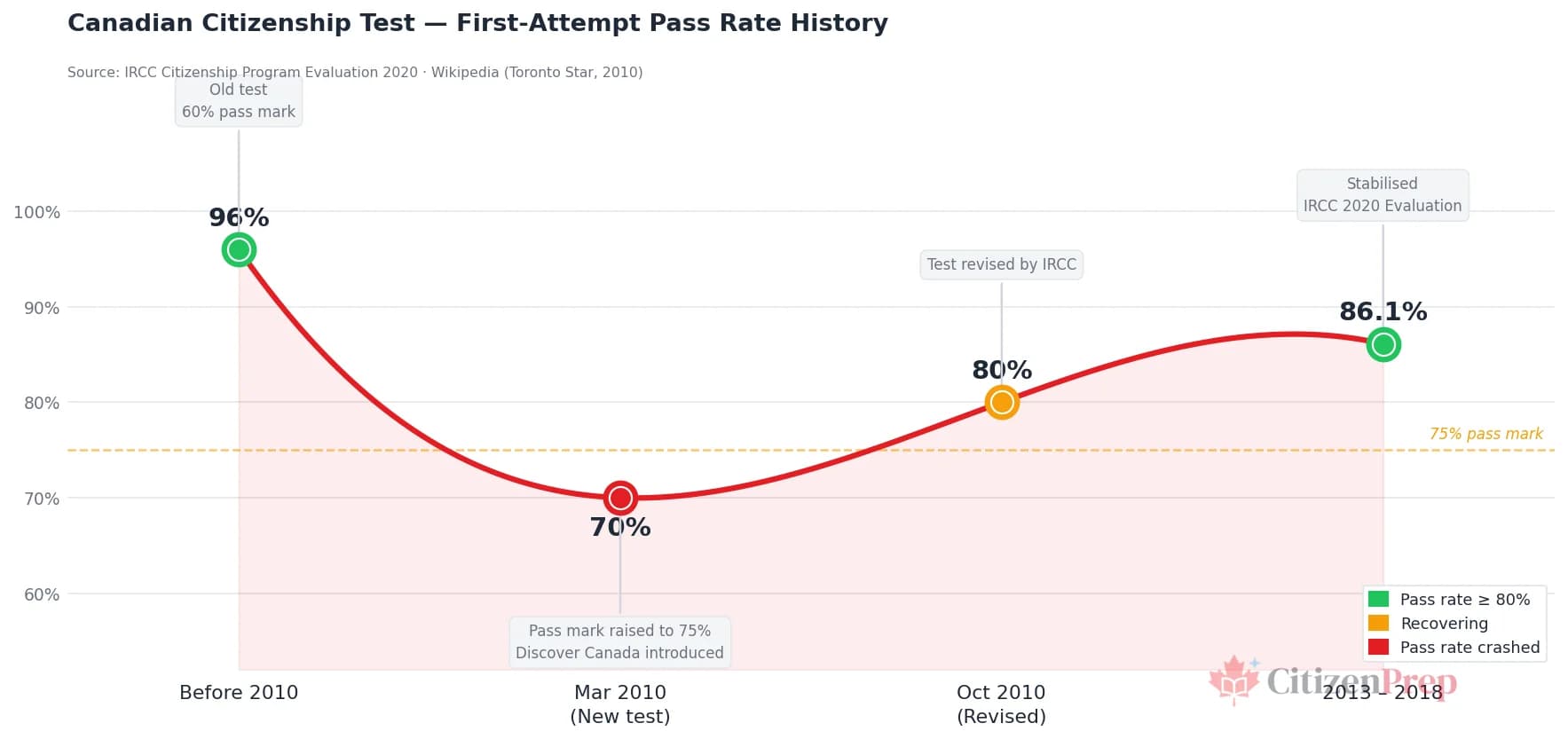
The big jump in 2010 happened because of two major changes:
- The passing score increased from 60% to 75% — a significant jump
- The study guide was replaced with Discover Canada, a much more comprehensive 63-page document covering history, government, rights, symbols, and geography
Before 2010, only about 4% of the roughly 145,000 annual test takers failed. After the new test launched on March 15, 2010, that failure rate spiked to 30% — a rate officials called "unacceptably high." IRCC revised the test in October 2010, bringing the failure rate down to around 20%.
By the 2013-2018 period, the first-attempt pass rate had stabilized at 86.1%, suggesting that applicants had adapted to the harder test and better study resources became available.
What score do you need to pass the Canadian citizenship test?
Who Passes and Who Struggles?
Not everyone has the same experience with the test. IRCC's data reveals some important patterns.
Time in Canada Matters
A CIC internal memo obtained through an Access to Information request found a surprising pattern:
| Time as PR in Canada | Pass Rate |
|---|---|
| Less than 5 years | Above 83% |
| More than 5 years | Low 70s |
This seems counterintuitive — wouldn't people who've lived in Canada longer know more? Not necessarily. People who apply for citizenship quickly tend to be more motivated and actively studying. Those who wait longer may feel less urgency to study, or may have been putting off the test due to anxiety.
Groups With Lower Pass Rates
IRCC's program evaluation found lower pass rates among:
- Applicants with secondary education or less at the time of admission
- Applicants with no official language knowledge (English or French) at admission
- Privately sponsored refugees and government-assisted refugees
This doesn't mean these groups can't pass — it means they may need more preparation time and different study strategies. If you fall into any of these categories, give yourself extra time and consider using tools that adapt to your learning pace.
What About Born Canadians?
Here's a humbling statistic: most Canadians couldn't pass their own citizenship test.
A Leger survey of 1,512 Canadian adults (June 2023) found that only 23% would pass the citizenship test. The average score was just 49% — well below the 75% passing threshold.
A separate Loans Canada survey found similar results: only 25% of Canadian-born respondents passed a mock test, while 27% of immigrants passed — slightly better.
So if you're nervous about the test, remember: you're studying material that most people born in Canada don't know. The fact that you're preparing already puts you ahead.
What Happens If You Don't Pass?
If you don't pass on your first attempt, you're not alone — roughly 14% of test takers don't. And the system is designed to give you multiple chances.
You get up to 3 attempts within your 30-day test window. Each attempt uses a new set of 20 questions randomly drawn from IRCC's bank of questions. You choose when to take each attempt — IRCC doesn't schedule them for you.
After 3 failed attempts, IRCC will usually invite you to a knowledge hearing — an oral interview with a citizenship officer lasting 30-90 minutes. Historically, about 80% of hearing candidates have been approved (based on earlier IRCC data), though current rates have not been published.
For a complete breakdown of what happens after failing, including how to prepare for a hearing, see our guide on what to expect from the online citizenship test.
How to Make Sure You Pass
Based on the data, here's what separates those who pass from those who don't:
1. Study the Right Material
The test is based entirely on the Discover Canada guide. Don't waste time with random online content — focus on content from the official source. Our chapter-by-chapter study guide breaks down what to prioritize.
2. Don't Cram — Study Consistently
The 86.1% pass rate suggests that most people who prepare properly do pass. The ones who struggle tend to cram the night before rather than studying steadily over weeks.
3. Take Practice Tests
Practice tests help you identify weak spots before the real thing. Check out our 50 practice questions to see where you stand.
4. Focus on the Hard Topics
According to test prep communities, the most commonly missed topics are:
- Government structure — levels of government, who does what
- Historical dates — Confederation (1867), constitutional amendments
- Rights vs. responsibilities — knowing which is which
- Provincial facts — your premier, lieutenant governor, legislature
- Indigenous history — treaties, residential schools, reconciliation
5. Know Your Test Format
Understanding how the online test works — the 30-day window, 45-minute time limit, webcam proctoring — removes anxiety on test day. No surprises means less stress.
Frequently Asked Questions
What is the Canadian citizenship test pass rate?
According to IRCC's Citizenship Program Evaluation (covering 2013-2018), the first-attempt pass rate is 86.1%. This means roughly 6 out of 7 people pass on their first try. IRCC has not yet published data for the online test format introduced in 2025.
What percentage of people fail the citizenship test?
Approximately 14% of first-time test takers do not pass (based on the 86.1% pass rate from IRCC's 2020 evaluation). However, with up to 3 attempts available in a 30-day window, most people who initially fail go on to pass.
Is the Canadian citizenship test hard?
For those who study the Discover Canada guide properly, the test is very passable — 86.1% pass on their first attempt. Most people who fail either didn't study enough or underestimated the material. With 4-6 weeks of consistent study, most applicants pass comfortably.
Could born Canadians pass the citizenship test?
Probably not. A 2023 Leger survey found that only 23% of 1,512 Canadian adults scored high enough to pass the citizenship test. The average score was 49% — well below the 75% needed. If you're studying for the test, you likely know more about Canada than most people born here.
What happens if you fail the citizenship test 3 times?
After 3 failed attempts within your 30-day test window, IRCC will usually invite you to a knowledge hearing with a citizenship officer. This is an oral interview lasting 30-90 minutes. Historically, about 80% of hearing candidates have been approved (based on earlier IRCC data). For full details on the test format and what to expect, see our guide on what to expect from the online citizenship test.
Do long-term residents pass at a lower rate?
Yes. A CIC internal memo found that permanent residents who lived in Canada for less than 5 years had a pass rate above 83%, while those who lived in Canada for more than 5 years had a pass rate in the low 70s. This is likely because recent applicants tend to study more actively.
Has the citizenship test gotten harder?
Yes. Before 2010, the failure rate was about 4%. When the new test launched in March 2010 with a higher passing score (75% vs. 60%) and the comprehensive Discover Canada study guide, the failure rate initially spiked to 30%. It has since stabilized at around 14% for first attempts.
Want to join the 86%? CitizenPrep uses adaptive learning to focus on your weak spots, so you study what matters most. 850+ concepts from the Discover Canada guide, bilingual support, and mock tests that match the real 2026 format. Start free — no credit card required.