
How Long to Study for the Citizenship Test?
You've got your citizenship test invitation. Now the question: how long do you actually need to study?
The honest answer: it depends. But not in a vague, unhelpful way. It depends on specific, measurable factors — and once you know where you stand, you can plan exactly how much time you need.
Here's what the data says, plus study plans for every timeline.
The Short Answer
For most people, 4-6 weeks of consistent study at 15-30 minutes per day is enough to pass comfortably. That's roughly 8-15 hours of total study time.
But "most people" covers a wide range. Some pass after 2-3 days of focused practice. Others need 8+ weeks. The difference isn't intelligence — it's preparation method, background knowledge, and language comfort.
The first-attempt pass rate is 86.1% (IRCC evaluation, 2013-2018), and the overall pass rate across all attempts is estimated at around 92% (based on 2022 ATIP data). Most people who study properly pass on their first try.
Factors That Affect Your Study Time
CIC News notes that "how much time it takes to study for the test can vary according to your learning style, prior knowledge of the subject, and study habits." Here's what that means in practice:
You'll need LESS time if:
- You already know Canadian history and government — maybe you studied it in school, follow Canadian politics, or have lived here a long time and absorbed the culture
- English or French is your first language — the Discover Canada guide is 63 pages of dense content; reading speed matters
- You're a strong test-taker — you're comfortable with timed multiple-choice exams
- You use active study methods — practice tests, flashcards, and quizzes rather than passive reading
You'll need MORE time if:
- English/French is your second (or third) language — you may need to read sections multiple times to fully understand them
- You're unfamiliar with Canadian history and government — if terms like "Confederation," "Governor General," and "Constitutional Act" are new to you, expect to spend more time
- You haven't taken a test in a while — test anxiety is real, and practice helps
- You learn best by listening or doing — the Discover Canada guide is text-heavy; you may need alternative formats (audio apps, video summaries) to absorb the material
IRCC's own evaluation found lower pass rates among applicants with less formal education, no official language knowledge at admission, and refugees — not because they can't learn the material, but because they may need more time and different study approaches.
Study Plans by Timeline
The 6-Week Plan (Recommended)
Best for: Most people. Comfortable pace with time to review weak areas.
| Week | What to Do | Time/Day |
|---|---|---|
| 1 | Read Discover Canada chapters 1-4 (history, Indigenous peoples) | 20 min |
| 2 | Read chapters 5-8 (Modern Canada, government, elections, justice) | 20 min |
| 3 | Read chapters 9-12 (symbols, economy, regions, provincial facts) | 20 min |
| 4 | Take first practice test. Identify weak areas. | 30 min |
| 5 | Re-study weak chapters. Take more practice tests. | 25 min |
| 6 | Final review. Take a full timed mock test. | 25 min |
Total time: ~12-15 hours
Supplement with: One concept per day throughout all 6 weeks.
The 2-Week Plan (Intensive)
Best for: People with some prior knowledge of Canada, strong English/French, or those who got a late test invitation.
| Week | What to Do | Time/Day |
|---|---|---|
| 1 | Read entire Discover Canada guide. Take a practice test on day 5. Note weak areas. | 45 min |
| 2 | Focus only on weak topics. Take a practice test every other day. Final timed mock on day 13. | 45 min |
Total time: ~10-12 hours
Supplement with: 50 practice questions and our guide to the hardest topics.
The 3-Day Sprint (Last Resort)
Is this enough? For some people, yes. On CanadaVisa forums, multiple users report passing with 2-3 days of preparation. One user shared: "Read the book casually once and then in detail a second time... 2 days prep is sufficient." That user scored a perfect 20/20 — after doing practice tests from a question bank for each subject area.
But this is risky. Other users studied for 3 weeks and still scored 14/20 (one short of passing). The difference? Study method matters more than study time.
| Day | What to Do | Time |
|---|---|---|
| 1 | Read Discover Canada cover to cover. Highlight key facts. | 3-4 hours |
| 2 | Take 3-4 practice tests. Focus on what you got wrong. Re-read those sections. | 3-4 hours |
| 3 | One more practice test in the morning. Review errors. Rest before the test. | 2 hours |
Total time: ~8-10 hours
What is the time limit for the Canadian citizenship test?
What Matters More Than Hours
The data is clear: how you study matters more than how long you study.
Active Learning Beats Passive Reading
A CanadaVisa forum user put it well: "Just reading the guide won't be enough because you need the information to stick, and only active learning (like multiple choice questions) helps."
Active methods (more effective):
- Practice tests with immediate feedback
- Flashcards (especially for dates, names, and definitions)
- Explaining concepts out loud in your own words
- Teaching someone else what you learned
- Adaptive learning tools that focus on your weak spots
Passive methods (less effective alone):
- Reading the guide straight through without stopping
- Highlighting without reviewing
- Re-reading the same sections without testing yourself
Focus on the Hard Topics
Don't spend equal time on everything. The 10 hardest topics cause the most failures. Government structure, historical dates, and rights vs. responsibilities deserve more study time than geography or symbols.
Take Practice Tests Early
Don't wait until the end to test yourself. Take a practice test in your first week — even before you've finished reading the guide. This shows you exactly what the test looks like and where your gaps are, so you can focus your remaining study time.
Try our 50 practice questions or the free Richmond Public Library practice test.
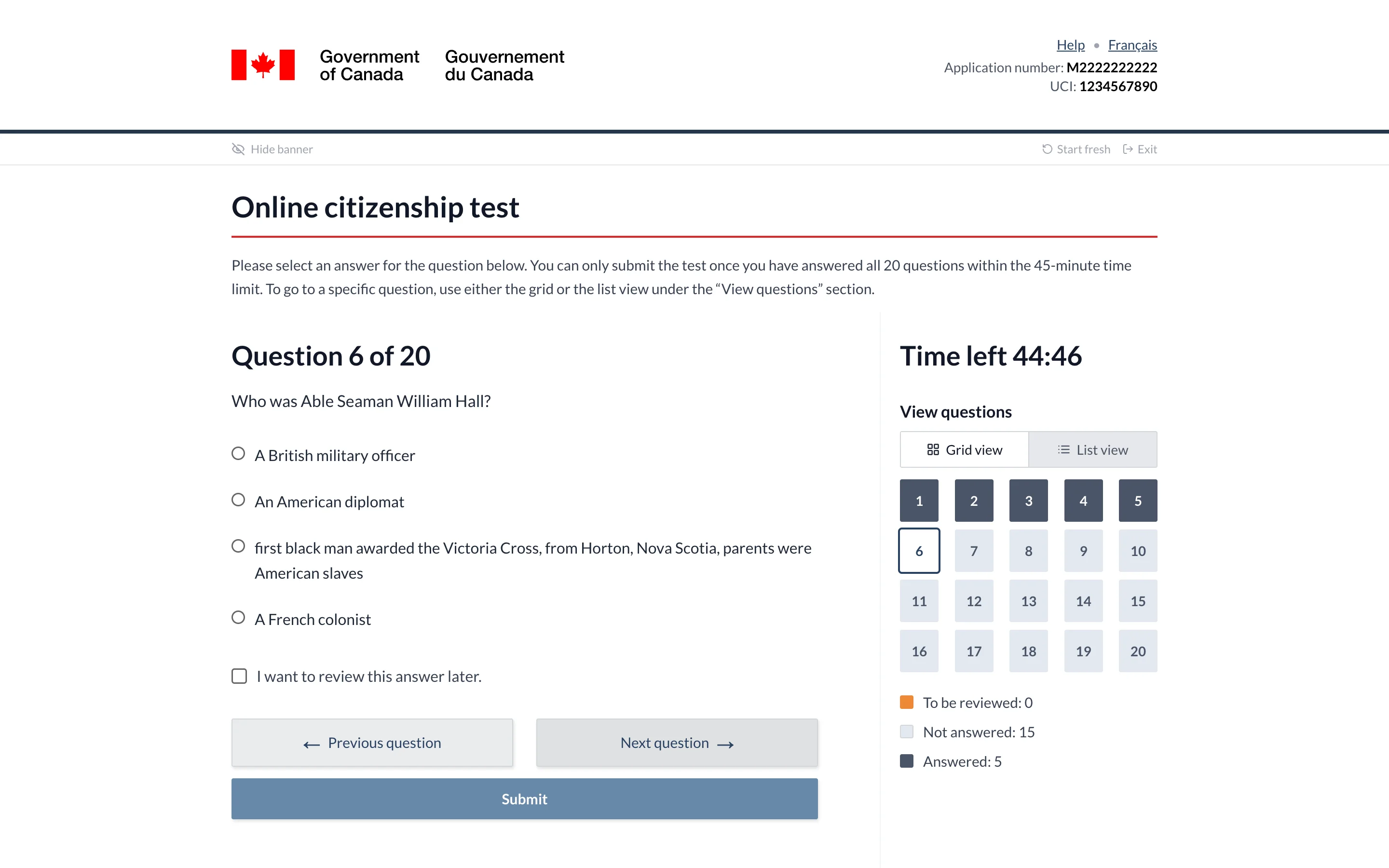
Try CitizenPrep free →
The Median Test Taker Finishes in 12 Minutes
Here's an interesting fact: according to ATIP data, the median time to complete the citizenship test is 12 minutes — even though you're given 45 minutes.
That means most people don't find the questions themselves difficult once they've studied. The challenge is knowing the material, not the time pressure. If you've prepared properly, you'll likely finish well before the timer runs out.
When Are You Ready?
You're probably ready to take the test when:
- You consistently score 80% or higher on practice tests (giving yourself a 5% buffer above the 75% passing score)
- You can explain the difference between Head of State and Head of Government without hesitating
- You know your province's premier, lieutenant governor, and legislature
- You can name the four original Confederation provinces and at least 3 key historical dates
- You understand the difference between rights and responsibilities
If you're scoring below 75% on practice tests, you're not ready yet — keep studying your weak areas.
Frequently Asked Questions
How long does the average person study for the citizenship test?
Most people study for 4-6 weeks at 15-30 minutes per day, totalling about 8-15 hours. However, some pass with as little as 2-3 days of focused preparation, while others need 8+ weeks. The key factor is study method, not just hours spent.
Can I pass the citizenship test without studying?
It's unlikely. Only 23% of born Canadians passed the test in a 2023 Leger survey, and they've lived here their whole lives. The test covers specific facts from the Discover Canada guide that most people don't know without studying — historical dates, government structure, constitutional documents.
Is 2 weeks enough to study for the citizenship test?
Yes, for many people. Two weeks of focused study (45 minutes per day) is enough if you have decent English/French skills and use active study methods like practice tests. It's tighter than the recommended 4-6 weeks, so you'll need to be disciplined about studying daily.
Is 3 days enough to study for the citizenship test?
Possible but risky. Some forum users report passing with 2-3 days of intensive preparation, but others who studied for weeks still failed. If you already have a strong foundation in Canadian knowledge and good English/French, a 3-day sprint can work. If not, give yourself more time.
What should I study first?
Start with government structure and Canadian history — these are the hardest topics and the most heavily tested. Then cover rights and responsibilities, your provincial government, and symbols. Geography and economy are usually the easiest sections.
How many hours total does it take?
Most people need 8-15 hours of total active study time, spread over 2-6 weeks. The exact amount depends on your background knowledge, language comfort, and how actively you study. Practice tests are the most efficient use of your time.
Should I read the entire Discover Canada guide?
Yes, at least once. Every test question comes from this guide. Read it cover to cover, then focus your review on the chapters where you scored lowest on practice tests. The guide is 63 pages — you can read it in 2-3 hours. Use our chapter-by-chapter study guide for a structured approach.
Want to study smarter, not longer? CitizenPrep uses adaptive learning to focus on your weak spots — so you spend your study time where it matters most. 850+ concepts, bilingual support, and mock tests that match the real 2026 format. Start free — no credit card required.